
If you are building an embedded device, IoT product, industrial controller, smart device, or software-enabled platform for the European market, the EU Cyber Resilience Act makes one thing very clear: Cybersecurity is no longer optional and neither is proof. The EU CRA documentation requirements are not just paperwork. They are the evidence that shows your product was designed, developed, tested, and maintained with cybersecurity in mind.
For Embedded manufacturers, OEMs, software providers, importers, and product teams, this documentation will become a critical part of keeping products legally available on the EU market after the CRA becomes fully applicable in December 2027.
The CRA does not only ask whether your product has Secure Boot, Secure OTA updates, encryption, access control, or vulnerability handling. It asks whether you can prove those controls exist, show how risks were assessed, and demonstrate how security will be maintained throughout the product lifecycle.
This is where many companies underestimate the work.
A secure product without documentation may still fail compliance. Under the CRA, engineering decisions must be backed by audit-ready evidence.
Why CRA Documentation Matters More Than Ever
Many embedded teams think compliance is mainly about adding security features such as Secure Boot, encrypted communications, secure update mechanisms, or user authentication.
Those controls are important, but they are only part of the story.
Regulators, market surveillance authorities, and conformity assessment bodies will want to know:
- Can you prove the product was designed securely?
- Can you show how cybersecurity risks were identified and mitigated?
- Can you demonstrate lifecycle support, vulnerability handling, and update readiness?
- Can your documentation survive audit scrutiny?
EU CRA Documentation is the legal and technical backbone of compliance. It connects engineering implementation with market access.
For embedded and IoT products, this means your documentation must reflect the real product architecture: boot process, firmware structure, software dependencies, update mechanisms, interfaces, cloud connectivity, security controls, and vulnerability response process.
The 3 Mandatory CRA Documentation Elements
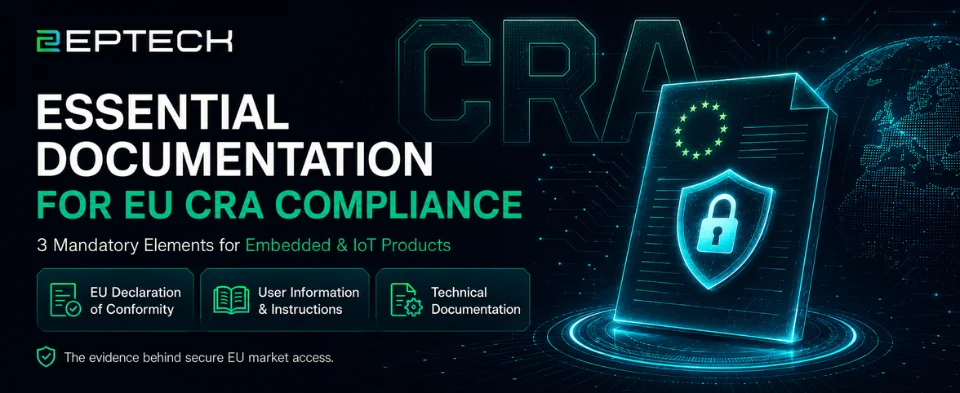
The CRA requires manufacturers to maintain three core documentation pillars:
1) EU Declaration of Conformity
2) Information & Instructions for Users
3) Technical Documentation (Audit Evidence File)
Each element serves a different purpose, but together they create the compliance proof your product needs.
1) EU Declaration of Conformity
The EU Declaration of Conformity CRA embedded manufacturers must prepare is a formal legal statement confirming that the product with digital elements meets the applicable CRA requirements.
Think of it as the product’s official compliance signature for EU market access.
It is prepared after the relevant conformity assessment procedure has been completed. By issuing it, the manufacturer or authorized representative accepts responsibility for the product’s compliance.
What it should include
A CRA-ready Declaration of Conformity should include:
- Product name, type, model, batch, or serial number
- Manufacturer name and address
- Statement that the declaration is issued under the manufacturer’s sole responsibility
- References to harmonized standards, common specifications, or cybersecurity certification schemes
- Notified Body name and identification number, if applicable
- Date of issue
- Name and signature of the responsible person
This document is not a marketing certificate. It is legally meaningful evidence that your product has completed the required conformity process.
For embedded products, the DoC should be supported by real technical evidence such as Secure Boot validation, OTA update controls, SBOM reports, firmware testing, and risk assessment outputs.
At Epteck GmbH, we help embedded and IoT manufacturers prepare CRA-ready declarations that are aligned with real engineering controls, not disconnected from the product architecture.
2) Information & Instructions for Users
CRA also requires manufacturers to provide clear user-facing information so customers can configure, operate, update, and maintain the product securely.
This is especially important for embedded devices, IoT systems, and connected products deployed in the field.
What it should include
User documentation should explain:
- Manufacturer contact details
- Vulnerability reporting contact point
- Product purpose and security properties
- Known cybersecurity risk conditions
- Secure setup and configuration steps
- How to install security updates
- Support period duration and scope
- Secure onboarding and credential handling
- Safe operation and maintenance guidance
User behavior directly affects cybersecurity. If customers do not understand how to configure, update, or maintain the product securely, even strong technical controls can fail in real-world use.
For example, a connected gateway manual should not only explain how to power the device. It should also explain how OTA updates are applied, what happens when updates are ignored, how credentials are managed, and where vulnerabilities can be reported.
Many OEMs fail here because product manuals are treated as an afterthought. Under CRA, user instructions are part of the cybersecurity evidence chain.
3) Technical Documentation (Audit Evidence File)
The technical documentation is the most detailed CRA evidence package. It shows how the product was designed, how cybersecurity risks were assessed, and how security controls were implemented.
For search intent around CRA technical file Annex V embedded, it is important to clarify one point: Annex V relates to the EU Declaration of Conformity structure, while the technical documentation content is addressed separately in CRA documentation requirements. In practice, manufacturers still need a complete technical file that supports the declaration and conformity assessment.
What it should include
A strong CRA technical file should include:
- General product description
- Hardware and software architecture
- Firmware, bootloader, and software structure
- Remote connectivity and cloud dependency scope
- Secure development procedures
- Cybersecurity risk assessment
- TARA threat modelling CRA documentation
- Security controls implemented in firmware
- Secure update strategy
- Vulnerability handling procedures
- SBOM CRA documentation embedded firmware
- Test reports and validation evidence
- CE marking and conformity assessment details
- CRA notified body technical evidence, if required
The goal is not to create more paperwork. The goal is to make sure your security claims are backed by evidence.
Key Technical File Sections for Embedded & IoT Products
Product Overview and Architecture Description
The technical file should start with a clear explanation of the product.
For embedded devices, this means documenting:
- Hardware platform
- MCU, MPU, SoC, or processor architecture
- Firmware structure
- Bootloader and operating system details
- Communication interfaces
- Cloud or remote data processing dependencies
- External components and third-party modules
- Security-relevant interfaces such as UART, JTAG, USB, Ethernet, BLE, Wi-Fi, or cellular
This section helps assessors and authorities understand what the product is, how it works, and where security boundaries exist.
Secure Development and Production Procedures
The CRA expects cybersecurity to be addressed during planning, design, development, production, delivery, and maintenance.
Your documentation should describe how security is built into the engineering workflow.
This may include:
- Secure coding practices
- Secure Boot implementation process
- Code review procedures
- Firmware signing process
- Key management approach
- Vulnerability scanning
- Dependency review
- Secure build pipeline
- Production provisioning process
- Release approval process
For embedded teams, this matters because security is often tied to low-level implementation decisions that cannot be fixed easily at the end.
TARA Threat Modelling CRA Documentation
A critical part of CRA documentation is risk assessment. For embedded and IoT products, this often means using TARA threat modelling CRA documentation as part of the technical file.
TARA stands for Threat Analysis and Risk Assessment. It helps teams identify what can go wrong, how attackers may target the product, how severe the impact could be, and what mitigations are needed.
A practical TARA section should cover:
- Assets that need protection
- Threat scenarios
- Attack surfaces
- Entry points
- Attack feasibility
- Potential impact
- Risk level
- Mitigation measures
- Residual risk
- Security requirements derived from the analysis
For example, if a device supports OTA firmware updates, a TARA process may identify risks such as malicious firmware injection, rollback attacks, credential compromise, or man-in-the-middle attacks. The resulting mitigations may include signed firmware, encrypted transport, rollback protection, secure key storage, and update audit logs.
TARA makes cybersecurity decisions traceable. It shows why a control was required and how it reduces risk.
CE Marking Documentation IoT CRA 2027
The CRA is closely linked with CE marking. Before placing a product with digital elements on the EU market, manufacturers must complete the applicable conformity assessment procedure, draw up the EU Declaration of Conformity, and affix the CE marking.
For connected products, CE marking documentation IoT CRA 2027 should show that cybersecurity requirements are part of the market access process, not a separate afterthought.
A well-prepared CE and CRA documentation package may include:
- Product identification
- Applicable legislation and standards
- Cybersecurity risk assessment
- Essential cybersecurity requirement mapping
- Test reports
- Secure update strategy
- Vulnerability handling process
- SBOM reports
- EU Declaration of Conformity
- User instructions and support period information
This is especially important for companies preparing products that will still be sold or updated after December 2027.
SBOM CRA Documentation Embedded Firmware
The SBOM CRA documentation embedded firmware section is becoming one of the most important parts of compliance evidence.
An SBOM, or Software Bill of Materials, is a structured inventory of software components used in the product. For embedded products, this may include:
- Firmware modules
- Open-source libraries
- Bootloader components
- Kernel packages
- Middleware
- Drivers
- Cryptographic libraries
- Third-party SDKs
- Build-time dependencies
SBOMs are important because vulnerabilities are often discovered after products have already shipped. Without an SBOM, manufacturers may not know which devices are affected by a new CVE or dependency risk.
A CRA-ready SBOM workflow should support:
- SPDX or CycloneDX formats
- Continuous generation during builds
- Open-source dependency tracking
- Version visibility
- Vulnerability monitoring
- Linkage to release records
- Evidence retention for audits
For embedded Linux products built with Yocto, Buildroot, or custom BSPs, SBOM automation should ideally be part of the CI/CD and release pipeline.
At Epteck, we help product teams integrate SBOM automation into embedded development workflows so documentation is generated continuously rather than rushed before certification.
Vulnerability Handling Procedures
CRA documentation must also show how vulnerabilities are handled during the product lifecycle.
This should include:
- Vulnerability intake process
- Public or customer-facing reporting contact
- Internal triage workflow
- Severity classification
- Patch development process
- Security update release process
- Incident reporting readiness
- Customer notification process
- Long-term support policy
For manufacturers, this is a major shift. Security responsibility continues after the product is placed on the market.
If a vulnerability is discovered in a deployed embedded product, the manufacturer must have a process for investigating, fixing, documenting, and communicating the issue.
CRA Notified Body Technical Evidence
Not every product will require third-party assessment, but higher-risk products may need evaluation by a Notified Body.
For products in important or critical categories, CRA notified body technical evidence becomes especially important.
A Notified Body will not simply look for marketing claims. It will look for documented proof that cybersecurity requirements have been met.
This may include:
- Risk assessment reports
- Security architecture documentation
- Secure Boot validation
- OTA update testing
- SBOM records
- Vulnerability handling process
- Firmware security test results
- Conformity assessment evidence
- Applied standards and certification references
Preparing this evidence early reduces the risk of delays during conformity assessment.
Retention Requirements: 10 Years Minimum
Manufacturers must retain all CRA documentation for:
1) At least 10 years
CRA documentation must be kept for a minimum of 10 years after the product has been placed on the EU market.
2) The full support period, if longer
If the product support period is longer than 10 years, documentation must be retained for the full support period.
CRA documentation is not a one-time file created before launch. It must remain available for audits, market surveillance requests, conformity checks, vulnerability investigations, and lifecycle support.
A practical retention system should include:
- Version-controlled technical files
- SBOM snapshots per release
- Test reports and validation evidence
- OTA update records
- Vulnerability handling records
- EU Declaration of Conformity copies
- User documentation history
Missing or incomplete documentation can lead to CE marking issues, product restrictions, recalls, fines, or delays in market access.
How Epteck Helps Embedded Companies Meet EU CRA Documentation Requirements
Most teams can implement isolated security features.
Fewer teams can connect engineering, testing, lifecycle support, and documentation into one CRA-ready system.
At Epteck GmbH, we support end-to-end CRA readiness for embedded and IoT manufacturers, including:
- Secure Boot implementation using U-Boot, MCU boot chains, TrustZone, TPM, and secure elements
- Secure OTA pipelines with signing, encryption, rollback protection, and traceability
- CRA gap analysis and TARA-based threat modelling
- SBOM automation using SPDX and CycloneDX workflows
- Firmware security testing and validation reports
- Vulnerability handling process design
- Audit-ready technical documentation for CRA, CE, and GPSR
- Notified Body preparation and technical evidence packaging
If you need compliance that survives audits, not just a checklist, we help build it into your product lifecycle.
Conclusion: CRA Compliance Is Engineering Plus Evidence
The EU Cyber Resilience Act is not only a cybersecurity regulation.
It is also a documentation discipline.
For embedded and IoT companies, the winners will be the teams that can prove their products are secure, maintainable, updateable, and supported across the lifecycle.
Strong documentation helps companies:
- Ship faster
- Avoid late redesigns
- Reduce certification surprises
- Support CE marking
- Respond to vulnerabilities
- Maintain EU market access after 2027
Documentation is not overhead. It is your product’s legal security passport.
Need help preparing CRA-ready documentation before 2027?
Epteck GmbH helps embedded manufacturers build Secure Boot, secure OTA compliance, SBOM evidence, TARA documentation, and complete audit-ready CRA technical files.
Book a free CRA readiness consultation: https://calendly.com/epteck/discovery
FAQs
What documentation does the EU CRA require?
The CRA requires an EU Declaration of Conformity, information and instructions for users, and full technical documentation. For embedded and IoT products, this technical documentation should include risk assessment, SBOM, vulnerability handling procedures, security controls, testing evidence, and conformity assessment details.
Do embedded devices need technical documentation under CRA?
Yes. Connected embedded devices sold into the EU need technical documentation that proves secure design, cybersecurity testing, vulnerability handling, lifecycle support, and update readiness.
Is an SBOM mandatory under CRA?
The CRA expects manufacturers to maintain software transparency and support vulnerability handling. For embedded firmware, an SBOM is a practical and important way to document software components, open-source dependencies, and supply chain exposure.
What is TARA in CRA documentation?
TARA stands for Threat Analysis and Risk Assessment. It identifies assets, threats, attack paths, likelihood, impact, mitigations, and residual risks. In CRA documentation, TARA helps prove that cybersecurity risks were considered and addressed during product development.
What is included in a CRA technical file?
A CRA technical file may include product architecture, firmware structure, remote connectivity scope, risk assessment, secure development process, SBOM, update strategy, vulnerability handling procedures, test reports, and conformity assessment evidence.
Who checks CRA documentation?
Market surveillance authorities can request documentation. Higher-risk products may also require review by a Notified Body, depending on product classification and conformity assessment pathway.
How can Epteck help with CRA compliance?
Epteck provides Secure Boot engineering, secure OTA pipelines, CRA gap analysis, TARA-based threat modelling, SBOM automation, firmware security testing, and audit-ready documentation for CRA, CE, and GPSR.